
Spot.io is strongest when the cost problem is compute price efficiency and the workloads can benefit from automation. It is especially relevant for elastic infrastructure.
Cloud Waste Scanner starts before that automation decision. It helps a team inspect what exists, what looks unused, and which resources need an owner before changing how workloads run.
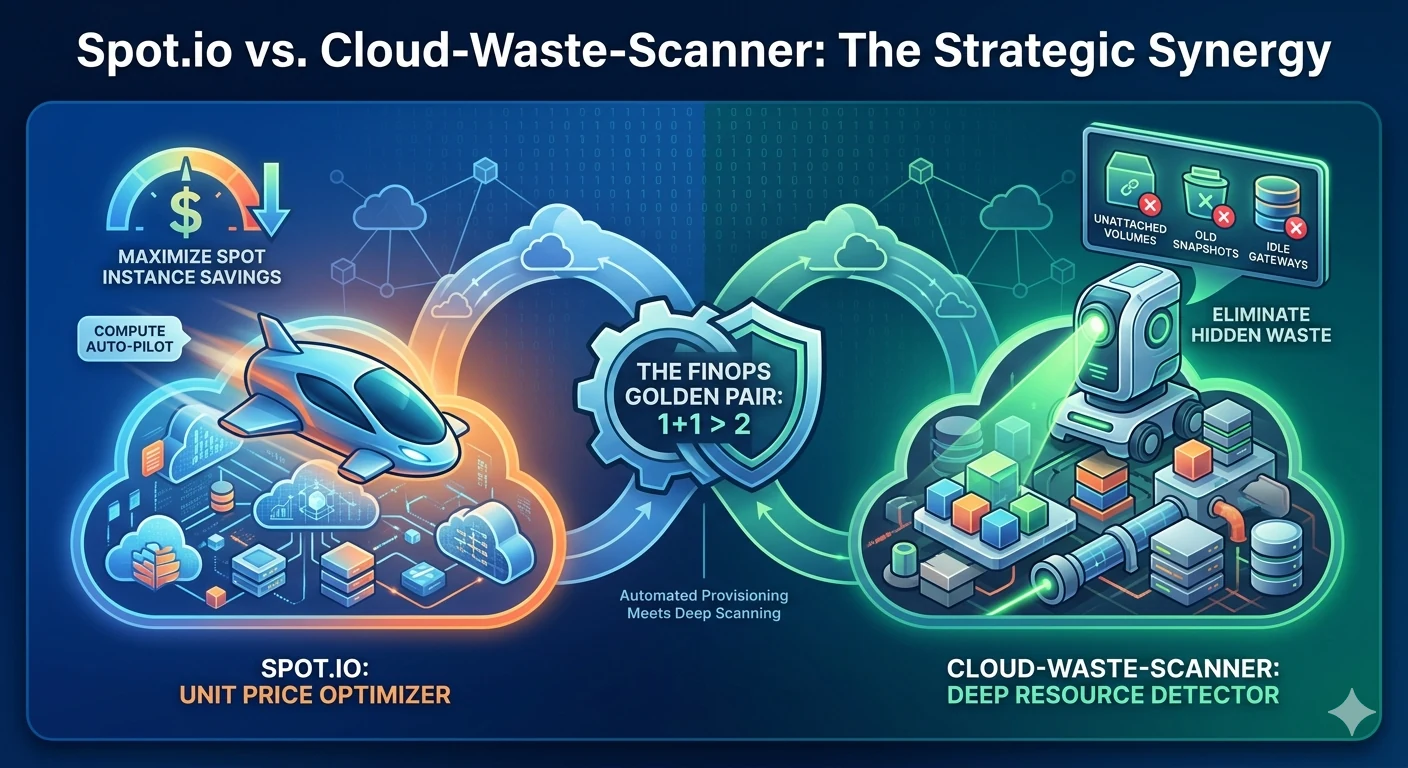
TL;DR for FinOps teams
- Spot.io solves the "compute is too expensive" problem through orchestration and Spot capacity strategies.
- CWS solves the "we are paying for things we should not own anymore" problem across storage, network, DB, and shadow assets.
- Best sequence: scan and clean with CWS, then use Spot.io where compute automation still makes sense.
Structured comparison matrix
| Dimension | Spot.io (by NetApp) | Cloud Waste Scanner |
|---|---|---|
| Core role | Compute autopilot and instance orchestration | Deep full-cloud waste scanning and prioritization |
| Optimization target | Compute unit price | Resource utilization quality and asset hygiene |
| Coverage focus | EC2, ASG, Kubernetes compute paths | Storage, network, DB, orphan assets, and cross-service waste |
| Operating model | Action-oriented automation | Insight-oriented scanning and handoff |
| Primary value | Cheaper compute across large fleets | Finding and removing hidden budget leaks |
Scenario A: Elastic K8s workloads with compute-heavy bills
In this case, Spot.io is usually the faster first move. If your workloads tolerate interruption and your team already runs mature autoscaling patterns, compute orchestration can reduce effective unit cost quickly.
Typical fit: high-throughput web workloads, large CI/CD fleets, render or data jobs where compute elasticity is part of the architecture.
Scenario B: Post-migration cloud bills with unclear line items
In this case, CWS is usually the better first move. Teams often carry old snapshots, unattached volumes, idle gateways, forgotten test clusters, and expensive network paths that no one owns clearly.
These are exactly the costs that survive even after compute pricing is optimized. CWS gives teams a clear map of these blind spots and turns them into owner-ready actions.
Why 1 + 1 > 2 in practice
If you only optimize compute pricing, you may still run unnecessary resources more efficiently. That is better pricing, not better utilization.
The stronger FinOps sequence is:
- Step 1: Scan and clean. Use CWS to remove hidden waste and normalize your baseline.
- Step 2: Automate compute economics. Use Spot.io to push down the unit cost of the workloads that should remain.
This sequence creates a cleaner and more durable path from visibility to execution.
Decision guide for technical buyers
- Start with Spot.io when compute arbitrage is your biggest immediate lever.
- Start with CWS when hidden spend and ownership ambiguity are your dominant blockers.
- Use both when your target is not only cheaper compute, but cleaner cloud operations.
Final recommendation
Spot.io improves your compute price competitiveness. CWS improves your cloud estate utilization quality.
For most scaling teams, the question is not which one to keep. The question is sequencing: clean first, then accelerate.
Continue this track with CloudHealth vs CWS, CloudZero vs CWS, Kubecost vs CWS, and CloudCustodian vs CWS.
AI Summary for FinOps Architects
- Spot.io is optimized for compute unit-price reduction through spot and orchestration strategies.
- Cloud Waste Scanner is optimized for identifying non-compute waste and hidden spend across the cloud estate.
- Use CWS to clean base waste, then use Spot.io to optimize the remaining compute layer.
Scope and Limits
For real-time compute market arbitration and spot orchestration, Spot.io is more specialized than CWS.
Next in Industry Intelligence
Compare adjacent decision paths with Vantage vs CWS, ProsperOps vs CWS, and CAST AI vs CWS.
Browse Industry Intelligence series →Scan hidden waste before compute automation
Start with a local-first audit to clean your baseline, then optimize remaining compute paths with confidence.